AI Security
Tokenmaxxing Is a Security Metric, and Nobody Is Measuring It That Way
Token-spend leaderboards are the hot productivity metric of 2026. They are also an unread map of where an organization's agentic blast radius is growing fastest.
AI Security
Token-spend leaderboards are the hot productivity metric of 2026. They are also an unread map of where an organization's agentic blast radius is growing fastest.
AI Security
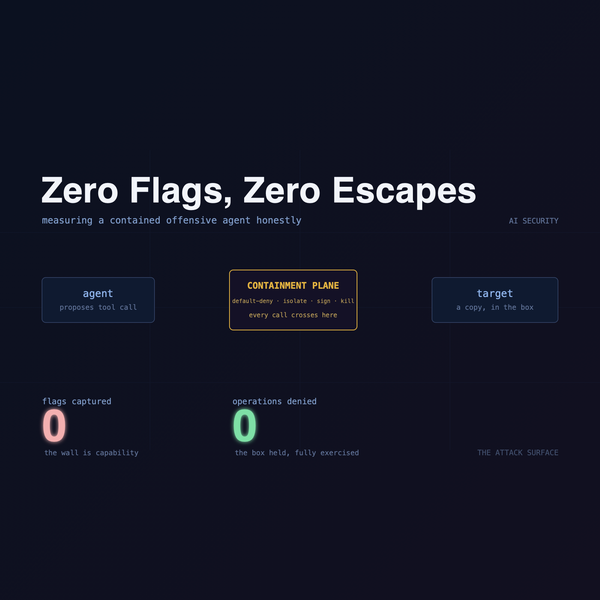
I built a contained harness to measure how good open models are at autonomous exploitation, then ran four of them against real OSS-Fuzz bugs. The result was zero solves and zero containment breaches. The honest part was proving the zero meant what I thought it meant.
AI Security
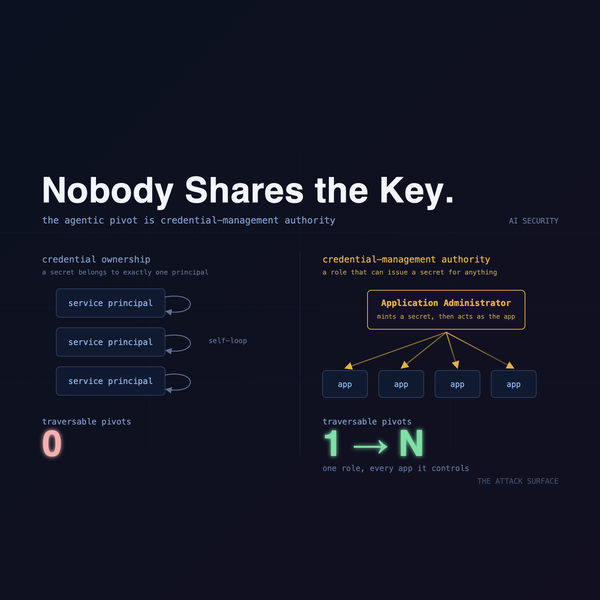
I modeled agentic lateral movement as a walk across shared secrets, then pointed it at a real Entra tenant and got zero pivots. The connector was not broken. A credential belongs to exactly one principal, and what moves an attacker sideways is the authority to mint a new one.
AI Security
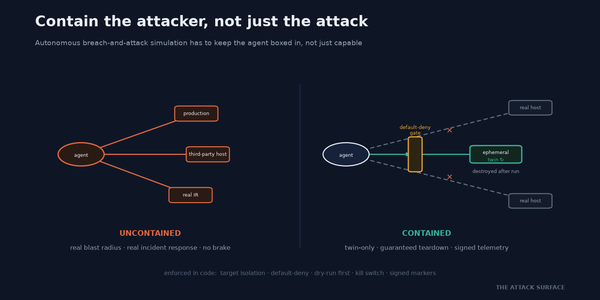
Breach-and-attack simulation is going autonomous: agents that pick and detonate real ATT&CK techniques with no human in the loop. The frameworks already run the attack. The unsolved problem is containing the attacker, and the discipline that contains it is what makes its measurements honest.
AI Security
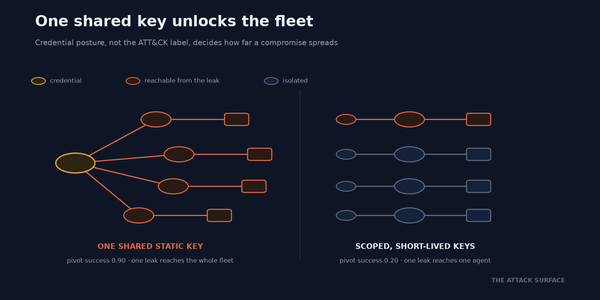
An AI agent is a credentialed insider, but a technique label like Valid Accounts cannot tell you which other agents a leaked key unlocks or how far the compromise spreads. In an agentic estate, lateral movement is a walk across shared secrets, and posture, not the ATT&CK label, decides its reach.
AI Security
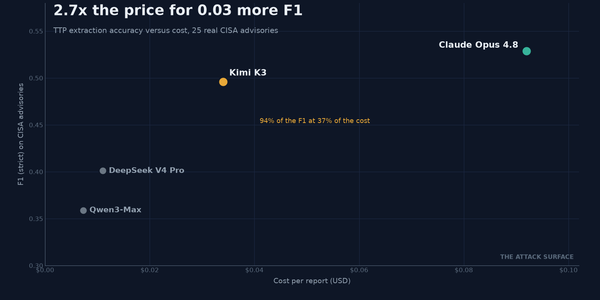
I ran four LLMs at mapping threat reports to ATT&CK. On easy hand-labeled reports they bunched together and the cheapest won. On 25 real CISA advisories with the answer key stripped, a clear ladder emerged: Claude leads on quality, Kimi K3 is the value pick, and the closed flagship finished last.
AI Security
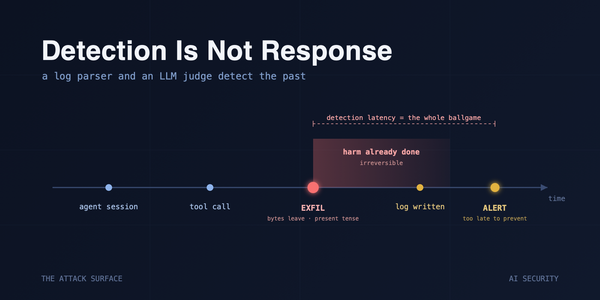
Uber open-sourced an 'Agentic AI Detection and Response' platform. The benchmark is a gift. The architecture can only detect the past.

AI Security
Anthropic's J-space research promises something like intent telemetry for AI agents. The opportunity is real, but it is not the logs we never had: it is a noisy, adversarially fragile sensor that needs an enforcement point you should have built anyway.

AI Security
Private data, untrusted content, and an exfiltration channel. When an agent has all three, someone else decides what it does with your secrets. Here is the pattern, drawn from three real breaches.

AI Security
AI agents have credentials, autonomy, and total gullibility. Stop securing them like software and start securing them like staff.